Proofreading Qualifications and Whether You Need One
You do not need a qualification to be a proofreader. No license exists for proofreading in the United States, the United Kingdom, Canada or Australia, and no law stops anyone charging for it. Proofreading qualifications do exist, from degrees to certification exams, but they are optional signals of skill rather than permission to work.
That freedom has a cost. With nothing to keep anyone out, nothing vouches for the people already in, so every new proofreader has to prove competence some other way. This guide covers the qualifications that exist, what each one tells a client, and what actually wins the first paid work.
Why proofreading has no license
A license does two jobs in a regulated trade. It keeps unqualified people out, and it vouches for the ones it lets in, so a client never has to judge competence for themselves. Proofreading has neither half, because a typo in a manuscript does not carry the public risk that faulty wiring does.
The result is an open field. Anyone who has been told they are good at spotting errors can advertise tomorrow, and many do. A client therefore has no shortcut for telling a trained proofreader apart from a confident amateur, which is why evidence matters more in this trade than in most.
Employment is a partial exception. Publishers, law firms and agencies set their own hiring requirements, and those often include a degree. That is a condition of one job, set by one employer, not a rule for the profession.
The proofreading qualifications that do exist
Several kinds of credential are available, and they signal quite different things. Some test skill directly, some show training, and some only show that a person paid to join something.
The main types line up like this.
| Credential | How it is earned | What it signals |
|---|---|---|
| A bachelor's degree | Three or four years of study, any subject | Reading stamina, often asked for in-house |
| Certification exam | Passing a timed, marked proofreading test | Tested skill at a stated standard |
| Assessed membership grade | Training, logged experience and review | Experience checked by a professional body |
| Course certificate | Completing a course and its assessment | Structured training in the core skills |
| Entry-level membership | Joining and paying a fee | Commitment, but no tested skill |
The differences matter when choosing where to spend time and money. A credential that tests skill or checks experience carries more weight with a stranger than one that records attendance, and an honest proofreader describes each one for exactly what it is.
Degrees and in-house jobs
Salaried roles lean on degrees. In O*NET's profile of proofreaders and copy markers, 47% of respondents said a new hire needs a bachelor's degree, 23% said an associate's degree, and 12% said some college. The same profile lists a 2025 median wage of $24.58 an hour for employed proofreaders.
The subject of the degree matters less than people expect. English is common, but a degree in nursing, law or engineering can be worth more, because it lets a proofreader work confidently on text a generalist would find hard going.
Certification exams and professional bodies
The closest thing to a formal test of skill comes from professional associations. Editors Canada certification includes a Certified Proofreader credential earned by passing a proofreading exam, and the association recommends about five years of full-time experience before sitting it. It states plainly that certification is voluntary.
In the UK, the Chartered Institute of Editing and Proofreading uses graded membership instead. The CIEP's membership grades run from Entry-Level, which anyone can join, through Intermediate and Professional to Advanced Professional, and every grade above entry requires an application showing training and experience.
Private course certificates sit alongside these. The Proofreading Institute's own C.P.B.P. certificate shows that a person completed the course and passed its exam. It is a private credential, not a degree, not a license and not membership of any professional body.
What wins proofreading work in practice
Clients hire on evidence of the work itself. A credential can get a proofreader onto a shortlist, but a short test edit, done well and returned on time, is what usually decides the job.
That pattern shows up early. Here at the Proofreading Institute, a little under half of the students who joined in the last two years told us a client or agency asked about their training before offering a test. The rest were simply sent a sample to mark up.
In rough order of how much they count with a new client, these are the things that get a proofreader hired:
- A clean test edit. Usually a few hundred words, marked to the client's style and returned quickly.
- Named standards. Saying which style guide and dictionary you work to separates trained practice from proofreading by instinct.
- Relevant subject knowledge. Years in medicine, law or finance let a proofreader catch errors a generalist would miss, and that is what higher rates pay for.
- Reliability. Meeting every deadline is the most common reason an agency keeps sending work.
- Credentials. Useful as supporting evidence, and last on purpose.
The order is the point. A newcomer with no degree and no certificate can still win work by leading with a strong test edit, while a well-qualified proofreader who misses a deadline rarely gets a second job from the same client.
When a qualification is worth getting
If clients hire on evidence, the case for a qualification rests on what it teaches and where it opens doors. Three situations make one worth the time.
- Aiming for in-house roles, where a degree or assessed membership is often a screening requirement.
- Moving into a regulated or technical specialty, such as legal, medical or academic work, where clients expect proof of subject knowledge.
- Learning the craft properly, so that the expensive mistakes happen on practice files rather than on a paying client's manuscript.
The third reason is the one most people underestimate. The costly errors in this trade are rarely spelling mistakes. They are quoting from a word count without seeing the file, agreeing a scope nobody defined, and changing text the proofreader was not entitled to touch.
Training fixes those faster than trial and error. A freelance proofreader resume template helps present whatever credentials a person has honestly, and the guide on how to get proofreading jobs covers where test edits come from.
How to judge a course before paying for it
Because the field is unregulated, so is the training. Anyone can sell a proofreading course and call its certificate a qualification, so the useful question is what the course makes a student do, not what it calls the result.
A few checks separate training that builds skill from training that only issues paper:
- Marked practice. Students proofread real passages and get specific feedback on what they missed, rather than only answering multiple-choice questions.
- Named standards. The course teaches to a published style guide, such as The Chicago Manual of Style, and explains how to build a style sheet for each client.
- The business side. Pricing, scope and client agreements are covered, because that is where new proofreaders lose the most money.
- An honest description of the credential. The provider says plainly what its certificate is and is not, and never claims it is required to work.
A course that passes all four is worth its fee for what it teaches. A course that leans on the certificate itself, or promises income, is selling the part of training that matters least to a client.
How the course builds the evidence clients look for
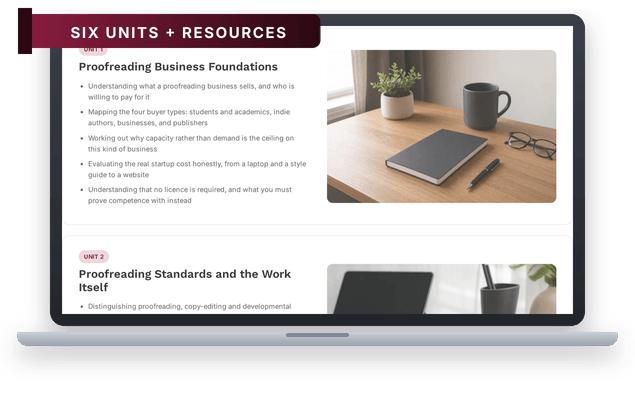
The Fundamentals course is built around that gap. Unit 2, Proofreading Standards and the Work Itself, covers where proofreading stops, how professionals mark up work, and the accuracy a paying client can expect. Unit 6, Getting Your First Clients, covers winning paid work without a license to point at.
The Advanced course adds Unit 7, Specializing and Higher-Value Clients, for choosing a specialty on evidence. The wider route into the work, including what to practice first, is set out in the guide on how to become a proofreader.
Ready to get started?
Our step-by-step courses take you from where you are now to a credential you can show, with templates, an online exam, and a 30-day money-back guarantee.
See the courses