Frequently asked questions
Honest answers about proofreading certification, what our course teaches, and how people actually get started as proofreaders.
About the courses
Is this course 100% online?
Yes. Every unit, quiz, assignment and the final exam are online, so you can study from anywhere at any time. There are no in-person classes, and because proofreading itself is usually done remotely, learning it this way matches how the work is actually done.
What's the course format like?
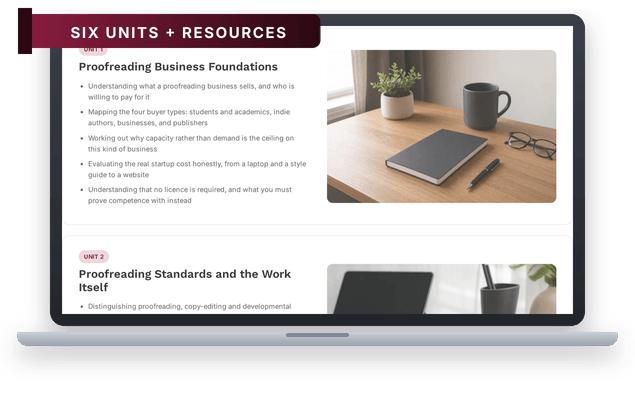
The course is written, not video, which suits a subject about reading closely. Each unit is a long read with worked examples drawn from real proofreading situations, such as pricing a manuscript from a sample or handling a disputed change, followed by a practice quiz and two short written assignments. You get access to your student dashboard as soon as you enroll.
What's included in the course content?
The Fundamentals includes the first 6 units: proofreading business foundations; proofreading standards and the work itself; setting up your business; pricing proofreading for profit; client experience and retention; getting your first clients. The Advanced adds the remaining 4: specializing and higher-value clients; marketing and being found; tools, workflow, and throughput; scaling, steady income, and long-term growth.
Do I need any special qualifications to enroll?
No. There are no entry requirements. You will get the most from the course if you already read carefully and write well, because the course teaches the standards and the business of proofreading rather than basic grammar. If you have a device and internet access, you can start.
Does the course teach grammar from scratch?
Not from scratch. The course assumes a good command of written English and focuses on what turns that into paid work: where proofreading stops, working to a named style guide, marking up a file, pricing, and finding clients. If you want a refresher on a rule, the style guide you choose to work to is the right reference, and the course shows you how to use one.
Pricing and guarantee
How much does the course cost in total?
We offer two options depending on how far you want to go. The Fundamentals course is $247 and the Advanced course is $498. You can compare both on the courses page.
Why does the course cost less than some editing programs?
Because it is narrower and delivered entirely online. It teaches proofreading and how to run a proofreading business, not the full range of editorial skills a longer program covers, and there are no classrooms or live sessions to pay for. That also means it is a different thing from those programs, which the certification questions below explain.
Will I have to pay any extra or ongoing fees?
No hidden charges, subscription fees, or renewal fees for the certificate. You pay once for your course. Optional add-ons are offered at checkout, and nothing else is charged later.
What if I change my mind or can't finish the course?
Both courses come with a 100% money-back guarantee. If you decide the training is not right for you, just email us within 30 days and we will refund your payment, no questions asked.
Certification and exam
Can you tell me more about the exam?
You take an open-book online exam of 30 multiple-choice questions and 4 short written answers. You need at least 70 out of 100 to pass. You get up to 2 attempts and a resit costs nothing, with no waiting period in between. The exam is one sitting rather than something you save and come back to, so give yourself a clear hour.
How long does marking take?
The multiple-choice half is scored the moment you submit. The written half is read by a person, usually within two business days, and your result arrives by email. If you do not pass, you get notes on what would have earned full marks rather than just a number.
Do I get a certification when I finish the course?
Yes. Once you complete the course and pass the exam, you receive a personalized digital certificate with your name and the date you finished, naming you a Certified Proofreading Business Professional (C.P.B.P.). It is a training certificate, and anyone can check it on our verification page.
What happens if I fail?
You resit it, at no cost, up to 2 attempts in total. Your result email tells you your score, splits it between the multiple-choice and written halves so you know where to focus, and includes any notes your marker left. You can sit it again as soon as you are ready.
Proofreading certification questions
Is the C.P.B.P. a license?
No. Proofreading is not a licensed occupation, so there is no government license to hold. The C.P.B.P. is a training certificate: it shows you completed this course and passed its exam, including written answers read by a person. You may mention it to clients as evidence of training, but it should never be described as a license, a degree or a professional membership. Our certification standards set out exactly what it represents.
Do I need a certification to become a proofreader?
No. No law requires a certificate to work as a proofreader, and many working proofreaders have none. Clients usually decide on a test edit, samples they can see and references. Training helps you learn the standards and the business side faster and gives you something concrete to point to, but it does not replace a good sample. Our guide on whether you need a qualification goes into this further.
Is an online proofreading certification worth it?
It depends on what you want from it. A certificate on its own will not win clients, because they judge you on your work. What good training gives you is a faster route to that work: knowing where proofreading stops, how to mark up a file, how to price from your own speed and how to approach clients. If you already have those, you may not need a course. If you do not, structured training saves a lot of trial and error.
Is this proofreading certification accredited?
No. The C.P.B.P. is not accredited by an outside body, and we do not claim it is. There is no official accrediting system for proofreading training in the way there is for degrees. The certificate is issued by us, against published standards, after an exam that includes written answers marked by a person, and each certificate can be verified online.
Can I get certified online?
Yes. The whole course, the exam and the certificate are online. You study at your own pace, sit the open-book exam when you are ready, and receive a digital certificate by email if you pass. Nothing requires you to attend anywhere in person.
How long does it take to get certified?
It depends on how much time you give it, because the course is self-paced and access does not expire. The units are substantial written lessons, each with a quiz and assignments, and you will learn more by applying each one than by reading straight through. The exam itself takes about an hour in one sitting. Some people finish in a few weeks, others spread it over months.
How much does proofreading certification cost?
Our certificate is included in the course price, which is $247 for Fundamentals and $498 for Advanced, and both tiers can sit the same exam and earn the same C.P.B.P.. There is no separate exam fee and no renewal fee. Other programs in the field are priced very differently, so compare what each one actually teaches. See the courses page for details.
How is this certificate different from ACES or CIEP credentials?
They are different kinds of thing. ACES (The Society for Editing) is a US professional association, and with the Poynter Institute it offers online editing certificates. The Chartered Institute of Editing and Proofreading (CIEP) in the UK offers training and graded membership, with higher grades based on evidence of training and experience. Our certificate is a course credential focused on proofreading and running a proofreading business. Many proofreaders hold more than one, and none is legally required.
Is a certificate the same as a university editing certificate?
No. Some university extension and continuing-education programs offer certificates in editing or copyediting, usually as longer programs covering a wider range of editorial skills. Our course is narrower: it teaches proofreading, the final check on edited text, and how to sell that service. If you want to work as a copyeditor, a broader program may suit you better. Our article on proofreading vs copyediting explains the difference.
How do I list the certificate on my resume or website?
Name it accurately, as the Certified Proofreading Business Professional (C.P.B.P.) from the Proofreading Institute, with the year. Describe it as a training certificate, and keep it beside your samples rather than in front of them. Clients can confirm it using the verification ID on our verification page. The resume template guide shows where it fits.
Starting out as a proofreader
How do I become a proofreader?
Most proofreaders start by choosing one kind of client, learning the style guide that client uses, measuring how fast they work, and building two or three sample edits they are allowed to show. From there it is a matter of offering test edits and approaching clients directly. Our step-by-step guide on how to become a proofreader covers each stage.
Do I need a degree to be a proofreader?
No. A degree is not required, although publishers and agencies often look for strong reading and writing skills, and a background in a subject such as law, medicine or science can help you specialize. What clients check in practice is your work, usually through a short test edit.
What is the difference between proofreading and copyediting?
Proofreading is the final check for errors and consistency, usually on text that has already been edited. Copyediting happens earlier and goes further, improving clarity, word choice and sentence structure. Clients often use the words loosely, so it is worth agreeing the scope in writing before you start. Our article on proofreading vs copyediting covers where the line falls.
How do I find proofreading jobs from home?
The most reliable routes are direct approaches to the kind of client you want to serve, such as authors, small businesses, academics or agencies, plus a small number of freelance platforms and directories. A clear offer and a test edit do more than a long profile. Our guide on how to get proofreading jobs covers where the work is and how to approach it.
Are proofreading jobs from home legit?
Many are, but the field attracts some scams. Be wary of anyone who asks you to pay to receive work, sends a large payment and asks you to return part of it, or offers high pay for very little work. Genuine clients ask about your skills and send a document; they do not ask for money up front. The proofreading jobs guide explains where legitimate work comes from.
How much do proofreaders make?
It varies widely with specialty, the clients you serve, your speed and how many hours you can work, so any single figure is misleading. What you can control is pricing from your own measured speed and choosing clients who value accuracy. Our guide on how much proofreaders make and the income calculator let you work through your own numbers.
How much should I charge for proofreading?
Start from a target hourly figure and your measured words per hour, then convert that into a per-word or per-page rate if a client prefers it. Quote from a sample of the actual text rather than the word count alone. The proofreading rate calculator does the conversions, and the guide to proofreading rates explains the thinking.
What does it cost to start a proofreading business?
Very little compared with most businesses. Most people need a computer they already own, a current style guide, possibly some software, a simple website and some form of professional insurance. The startup cost calculator lets you add up your own figures, and the guide to starting a proofreading business covers registration and setup.
After you enroll
How do I log in? I never set a password.
There is no password. Enter your email address on the sign-in page and we send you a six digit code that lasts ten minutes. The code only works in the browser that asked for it, so request it on the device you want to use. If it does not arrive, wait a minute before asking for another one, and check your spam folder.
I paid but my course is not showing.
Payments are confirmed by our payment provider a moment after you pay, and access opens automatically when that lands. If you sign in during that gap you will see a page saying we are confirming your payment, and it opens your course by itself. If it has been more than a few minutes, email us with the reference on that page.
Where is my invoice or receipt?
Sign in and open your account page. Every purchase is listed there with its invoice number, and the "Open billing and receipts" button takes you to our payment provider where you can download the receipt itself.
Can I upgrade from Fundamentals to Advanced later?
Yes, and you only pay the difference rather than the full price. The option is on your dashboard once you are signed in. It charges the card you enrolled with, and if that card no longer works you can complete it at the normal checkout instead.
Do the assignments get graded?
No. They are yours to work through and nobody marks them. They matter for a different reason: the written half of the final exam is drawn from the first assignment question in units 1 to 4, and your own answer is already in the box when you sit it.
Does the unit quiz count toward anything?
No. Each unit quiz is practice, your score is not reported to anyone, and it has no effect on your certificate. It exists so you can check something landed before building on top of it. The final exam is the one that counts.
Is there a time limit to finish?
No. Access does not expire, there is no schedule, and nothing is lost if you put it down for a few months. Your progress is saved as you go.