What Does a Proofreader Do?
A proofreader is the last person to check a document before it is published, printed or sent. Proofreading is that final check. A proofreader finds the errors that remain in a near-finished text (typos, missing words, inconsistent spelling and punctuation, and layout faults) and marks them for correction without rewriting anything that is already correct.
That definition sounds narrow, and in one sense it is. A proofreader is not there to improve the writing. But the job covers more ground than most people expect, because "near-finished" includes the page layout, the captions, the contents list and the running heads, and every one of those can carry an error the author never saw.
Where proofreading sits in the publishing process
Proofreading only makes sense once the order of the work is clear. A text passes through several hands before it reaches a reader, and each stage has a different job. The proofreader comes last because the earlier stages keep changing the text, and checking a page that will be rewritten tomorrow wastes everyone's money.
For a traditionally published book, the sequence usually runs like this.
- 1
Writing and revision
The author drafts and reworks the text, often with feedback from an agent, editor or beta readers.
Hands on a complete manuscript - 2
Structural editing
An editor looks at the shape of the whole, such as the order of chapters and whether the argument or story holds.
Hands on a settled structure - 3
Copy editing
A copy editor works sentence by sentence and builds the style sheet that records every decision on spelling and style.
Hands on a clean file and a style sheet - 4
Typesetting
The file is laid out into pages, which is where new faults such as bad line breaks and wrong page numbers appear.
Hands on the proofs - 5
Proofreading
The proofreader checks the proofs against the style sheet and marks what is still wrong, then checks that corrections went in.
The Editorial Freelancers Association's service definitions describe proofreading in the same terms, as one of the last stages before publication. In traditional publishing, they note, the proofreader compares the latest stage of the project to the previous one and confirms every change was made correctly.
Outside book publishing the order is often compressed. A small business may skip straight from a draft to a proofreader, and a student's dissertation may never be typeset at all. The principle stays the same, though. Proofreading is the check on a text that is meant to be final, and the question it answers is whether anything is still wrong.
What a proofreader checks
Because the text is meant to be final, a proofreader reads for accuracy and consistency rather than for style. In practice that means working through a set of distinct checks, some on the words and some on the page around them.
The checks on the words themselves include:
- spelling, including names, places and technical terms, checked against the style sheet or a stated dictionary
- punctuation, such as missing full stops, stray commas and unmatched quotation marks or brackets
- grammar errors that are plainly wrong, such as a verb that no longer agrees with its subject after an edit
- repeated or missing words, the errors a writer's own eye skips most often
- consistency, so a term, a hyphenation or a number style is used the same way from the first page to the last
The checks on the page matter just as much, because they only exist once the text has been laid out. A proofreader confirms that page numbers run in order, that the contents list matches the chapter titles, and that headings, captions and running heads are correct.
Layout faults are the other half of the page check. A proofreader flags a heading stranded at the foot of a page, a single line left alone at the top of the next, and a word split badly across two lines.
The O*NET profile of proofreaders and copy markers describes the same work in plainer terms. Its listed tasks include marking copy to correct errors in type, arrangement, grammar, punctuation or spelling, comparing figures against the original copy, and reading corrected proofs to make sure every correction has been made.
That last task is easy to overlook and is a large part of the job. A correction can introduce a new error, such as a reflowed paragraph that pushes a heading onto the wrong page. So a proofreader on a book often sees the same pages twice, once to mark them and once to confirm the fixes.
What a proofreader does not do
Knowing where the job stops is as important as knowing what it covers. A proofreader does not rewrite sentences that are clumsy but correct, restructure an argument, or change the author's voice. If a sentence is ambiguous, or a fact looks wrong, the proofreader writes a query (a short, polite question in the margin) and leaves the decision to the author or editor.
That restraint is what separates proofreading from the stage before it. Clients often blur the line, and our guide to copy editing vs proofreading sets out where it falls and why quoting for one and delivering the other causes trouble. The short version is that a proofreader confirms the text is right, while a copy editor decides how it could be better.
Accuracy, not polish, is what clients are paying for. In O*NET's survey of people in the role, 94% said being exact or accurate is extremely important to the work. Here at the Proofreading Institute, nearly every client brief students have shared with us over the past year named accuracy before turnaround or price.
Who hires proofreaders, and in what formats
Proofreading work comes from any organization or person that publishes words and would be embarrassed by an error. The clients fall into a handful of groups, and each tends to send work in its own format.
| Client | Typical work | Usual format |
|---|---|---|
| Publishers | Typeset proofs of books and journals | PDF proofs, marked with comments |
| Self-publishing authors | Final manuscripts before upload or print | Word file with tracked changes |
| Students and academics | Theses, dissertations and journal articles | Word file, within the university's rules |
| Businesses | Reports, websites, brochures and proposals | Word, PDF or a shared online document |
| Agencies | Overflow work from their own clients | Whatever the agency's system uses |
| Legal and medical firms | Contracts, filings and patient materials | Word or PDF, often under confidentiality terms |
The format shapes the work more than a newcomer expects. On a Word file, a proofreader usually makes corrections directly with tracked changes switched on, so the client can accept or reject each one. On a PDF proof, nothing can be changed directly, so every correction is a comment or a mark, and the typesetter makes the change.
Paper still exists too. Some publishers send printed proofs and expect corrections in the margins using the standard proofreading marks, a shorthand of symbols for deletions, insertions and transpositions. Paper proofs are less common than they once were, but the marks still shape how corrections are written on screen.
Academic proofreading has its own limits
Student work is the one area where the boundary is set by someone other than the client. Many universities publish rules on what a third-party proofreader may change in assessed work, usually allowing corrections to spelling and punctuation but not to content or argument. A proofreader taking student work reads those rules first, because the student carries the risk if they are broken.
What the job is like day to day
Day to day, the work is quiet, close and repetitive, which suits some people and not others. A freelance proofreader might spend a morning on a 40-page business report, an afternoon on two chapters of a novel, and the last hour on a client's corrections from yesterday.
Speed matters, but only after accuracy. The Editorial Freelancers Association's rate chart reports median proofreading paces of 10 to 15 pages an hour for fiction and 7 to 12 for nonfiction, with a page counted as 250 words. Technical and medical text runs slower, because more of it has to be checked against a reference.
Much of the rest of the job is communication. A proofreader agrees the scope before starting, asks for the style sheet, sends queries in a form the client can answer quickly, and delivers a short note on anything that affects the whole document. Those habits are what turn a single job into a client who comes back.
Learning the work properly
Anyone thinking about doing this professionally can start with our guide on how to become a proofreader, which covers the skills, the practice and the route to a first paid job.
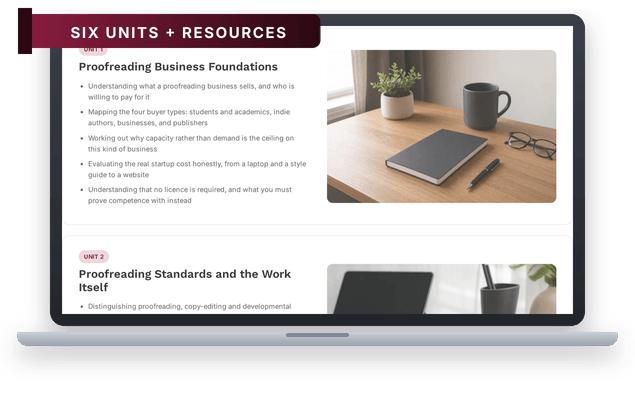
The Fundamentals course goes further on the work described here. Unit 2, Proofreading Standards and the Work Itself, covers where proofreading stops, how professionals mark up work on paper and on screen, and how to write a query rather than make a change you are not entitled to make. Unit 1 sets out who pays for proofreading and what a proofreading business actually sells.
Ready to get started?
Our step-by-step courses take you from where you are now to a credential you can show, with templates, an online exam, and a 30-day money-back guarantee.
See the courses