Certification standards
These standards explain what the Certified Proofreading Business Professional (C.P.B.P.) credential represents and how it is awarded, so students, clients, and employers can trust what it stands for.
1. What the credential represents
The C.P.B.P. credential signifies that the holder has completed Proofreading Institute training and demonstrated a working knowledge of how to set up, price, and operate a professional proofreading business, and how to win its first clients. It recognizes practical business readiness. It is not a license, and it does not replace any registration, insurance, or permit required in the holder's location.
2. Eligibility
Any enrolled student may work toward the credential. There are no prior education or experience requirements to begin. The certification is available to students of both the Fundamentals and Advanced courses.
3. How candidates are assessed
To earn the credential, a candidate must complete their course and pass the final assessment. The assessment is an open-book online exam combining multiple-choice and short written answers. A candidate must score at least 70 out of 100 to pass. Multiple-choice answers are graded automatically; written answers are reviewed by our team to confirm genuine understanding rather than recall alone.
4. What the exam checks, unit by unit
The exam is built from the course units, so passing it means a candidate has shown each of the following.
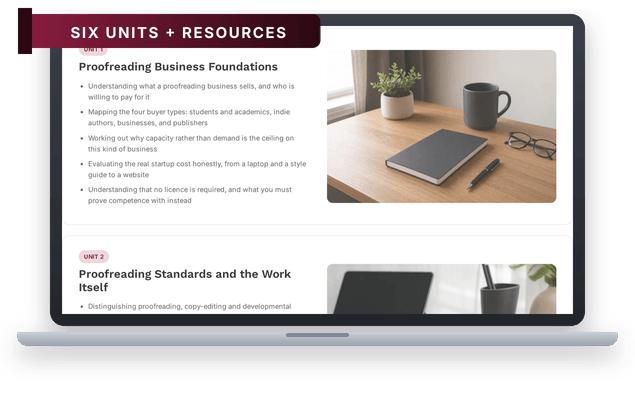
- Proofreading Business Foundations. Explains what a proofreading business sells and to whom, distinguishes the four buyer types by what each fears, identifies capacity as the ceiling on income, and costs a first month from real figures.
- Proofreading Standards and the Work Itself. Separates proofreading from copyediting, line editing and developmental editing, works to a named style guide, builds a style sheet, marks up in tracked changes, PDF or on paper, and queries rather than overreaches.
- Setting Up Your Business. Sets up a home-based proofreading business with a suitable structure, written terms covering scope, turnaround, revisions and non-payment, simple bookkeeping, cross-border payment, and confidential handling of unpublished manuscripts.
- Pricing Proofreading for Profit. Prices proofreading from measured words per hour, converts between per-word, per-page and per-hour rates, quotes from a sample rather than a word count, and prices rush and heavy files separately.
- Client Experience and Retention. Onboards a client with a clear brief, communicates promptly when a file is worse than its sample, delivers work with a usable summary, and distinguishes an error from a preference when a change is disputed.
- Getting Your First Clients. Chooses one buyer type, assembles proof a stranger can check such as sample edits and a test edit, judges which platforms produce paid work, and runs a tracked sequence of direct approaches.
- Specializing and Higher-Value Clients. Chooses a specialty on evidence, learns the conventions its clients assume, confirms what an academic integrity policy permits before starting, and prices work by the risk it carries.
- Marketing and Being Found. Builds a simple site that converts one visitor, targets the words buyers actually search for, shows competence without breaching client confidentiality, and sustains outreach alongside paid work.
- Tools, Workflow, and Throughput. Runs a repeatable workflow from file receipt to delivery, uses software for searches rather than as a substitute for reading, builds checks around personal errors, and schedules against real capacity.
- Scaling, Steady Income, and Long-Term Growth. Moves from one-off jobs to retainers, raises rates with existing clients, subcontracts overflow while staying accountable for quality, and plans for the seasons of academic and publishing work.
5. How the C.P.B.P. fits alongside licenses and other certifications
Proofreading is not a licensed occupation. In the United States, the United Kingdom and most other countries there is no government license, registration or exam that a person must hold before charging for proofreading, and no law requires any certificate to do the work. Clients decide whom to hire on evidence they can check themselves, most often a short test edit, a sample of previous work they are allowed to see, and references. The guide to whether you need a qualification covers this in more detail.
The C.P.B.P. (Certified Proofreading Business Professional) is a training certificate. It shows that the holder completed this course and passed its exam, including written answers read by a person. It is not a license, a degree, or membership of any professional association, and it is not accredited by an outside body. Holders should describe it in exactly those terms.
Other credentials in the field do different jobs, and they can sit alongside this one. In the United States, ACES (The Society for Editing) is a professional association that, with the Poynter Institute, offers online editing certificates at introductory, intermediate and advanced levels. In the United Kingdom, the Chartered Institute of Editing and Proofreading (CIEP) is a membership body with training courses and graded membership, where the higher grades require evidence of training and experience. Some university extension and continuing-education programs also offer certificates in editing or copyediting. None of these is a legal requirement either.
It also helps to be clear about the work itself. Proofreading is the final check for errors and consistency against an agreed style, usually on text that has already been edited. Copyediting comes earlier and goes further, into word choice, clarity and structure at the sentence level. This course teaches proofreading and the business of selling it; the comparison of proofreading and copyediting explains where one ends and the other begins.
6. Issuing the certificate
On passing, each candidate receives a personalized digital certificate showing their name, the course completed, and the date of issue. Every certificate carries a unique verification ID so its authenticity can be confirmed independently at any time.
7. Validity and use
The credential does not expire and carries no renewal fee. Holders may reference it in their marketing and client communications, provided they represent it accurately, as a sign of completed training, not as a government license or a guarantee of any specific result.
8. Maintaining standards
Holders are expected to uphold the Member Code of Conduct. We reserve the right to revoke a credential obtained through dishonesty in the assessment, or used to misrepresent the holder's qualifications. Revoked credentials are marked invalid on the verification page.
9. Verifying a certificate
Anyone can confirm a certificate is genuine on our certificate verification page by entering the verification ID printed on it.
Questions about these standards? Contact us.