How to Become a Freelance Proofreader
To become a freelance proofreader, you set yourself up as a small self-employed business. That means choosing a kind of text and client, proving your accuracy with samples or a test, registering the business and its tax obligations, writing terms and prices, and approaching clients directly. No license is needed in the United States.
Book proofreading is a common goal, and it works differently from proofreading a report or a thesis. A book passes through several proof stages, and a freelancer needs to know which stage a job sits at before quoting. Both halves are covered below, the business setup first and then the books.
What freelance proofreading involves
A freelance proofreader is paid by the job rather than by an employer, so they carry the whole business. The IRS self-employed individuals tax center counts anyone carrying on a trade as a sole proprietor or independent contractor, including part time, as self-employed, with an annual return due once net earnings reach $400.
That status changes the shape of the week. Proofreading is the paid part, but a freelancer also quotes, invoices, keeps records, sets aside tax and finds the next client. The proofreading itself has to be good enough to sell, which is a separate question covered in the guide to becoming a proofreader with no experience.
Freelancing suits proofreading well because the work is portable. A file arrives by email, the marked-up version goes back the same way, and the client rarely cares where the proofreader sits. The trade-off is income that varies month to month until a base of regular clients builds up.
How to set up as a freelance proofreader
The setup is mostly administration, done once and then kept tidy. Doing it in a sensible order avoids rework, such as printing invoices under a name you later change. The sequence below suits most new freelancers in the United States.
- 1
Choose a specialty and a buyer
Decide whose work you will check first, such as indie novelists or graduate students.
A clear market for the name and the samples - 2
Pick a business name
Check that it is free to use and that a matching web address is available.
- 3
Choose a structure and register
Most start as sole proprietors, and the state or county sets any registration needed.
- 4
Sort out tax and banking
Plan quarterly estimated tax and open a separate account for business money.
- 5
Write terms and prices
Cover scope, turnaround, revisions, payment and what happens on late payment.
- 6
Prepare samples and approach clients
Build a short portfolio and start direct outreach to the chosen buyer.
Registration rules vary by place. The Small Business Administration's guide to launching a business explains structures, names, tax IDs and local licenses, and points to the state and local offices that decide what applies. A sole proprietor trading under their own name often needs little, while a trade name may need filing.
The name deserves more thought than it usually gets, because it appears on every invoice and email. The proofreading business name generator suggests options to check against your state's business register. The fuller walk-through, from business plans to startup costs, is in the guide on how to start a proofreading business.
Terms protect the freelancer more than the client. A written scope stops a proofread from turning into an unpaid copyedit, and a deposit on long jobs limits the damage of a client who disappears. A proofreading services contract template gives a starting point to adapt.
How book proofreading works
Proofreading a book is a defined stage in a longer process. The Editorial Freelancers Association's service definitions describe it as among the last stages before publication, and in traditional publishing as a review of the publisher's proof, the document that is intended to be printed, comparing it with the previous stage.
Most books pass through the stages below, though the names vary between publishers.
- Manuscript. The copyedited text, usually a Word file, before it is laid out as pages.
- First proofs. The typeset pages, often called galleys, where the main proofread happens.
- Advance reader copies. Early copies, usually printed from uncorrected proofs, sent to reviewers and booksellers before publication. They are a marketing tool, not a stage to correct.
- Second proofs. Revised pages, checked to confirm that every marked correction was made and nothing new went wrong.
- Final files. The pages signed off for print and ebook.
Which stage a job sits at changes both the work and the price. A first-proof read checks every line for errors and layout faults, such as bad word breaks and stranded headings, while a second-proof check concentrates on the corrections. Quoting one at the other's rate costs money.
Page proofs also carry checks that a manuscript never needs. Running heads have to match the chapter they sit over, page numbers have to run in sequence, and the contents list has to point at the right pages. Captions must sit with their images, and a single short line stranded at the top of a page is usually flagged for the typesetter to fix.
Those checks are why book proofreading is a skill of its own rather than a slower version of checking a report. A proofreader who has only worked on Word documents should practise on a few typeset PDFs before taking on a paid book.
Proofreading books for publishers
Publishers hire freelance proofreaders for first and second proofs, and most expect a proofreading test before the first job. The work arrives as PDF pages with a house style guide and, often, the copyeditor's style sheet. Corrections go back as PDF comments, or as marks on paper for a few houses.
Rates are usually set by the publisher, and the volume is steady once a proofreader is on the freelance list. The trade-off is that getting onto that list takes persistence, a clean test and, often, a referral from someone already working for the house.
Proofreading books for self-published authors
Independent authors are the other main market, and they often come with less structure. Some send a Word manuscript before formatting, others send a PDF from a formatter, and some are unsure which stage they need. Asking which file is final, and who will make the corrections, avoids most later disputes.
The file format varies as much as the stage. Here at the Proofreading Institute, students who proofread books over the past year were split about evenly between jobs that arrived as Word files and jobs that arrived as PDF proofs.
A freelancer who handles both comfortably can take whichever an author has. That flexibility pays off over time, because an author who is looked after on one book tends to come back with the next, and often recommends the proofreader to a writing group as well. A series author can become a standing client in a way a one-off business report rarely does.
Finding your first freelance proofreading clients
The first clients usually come from direct approaches rather than from waiting. A short list of target buyers, a sample edit relevant to them, and a polite message that names what you would check gets more replies than a general profile on a busy platform.
The approaches below tend to produce early book and business work, listed roughly in order of how quickly they pay off.
- Writing groups and author communities, where indie authors ask for recommendations.
- Small presses and university presses, approached with a short note asking about their freelance test.
- Editors and copyeditors who need a proofreader to follow their own work.
- Agencies that assign proofreading after a test edit.
The guide on how to get proofreading jobs covers these routes in detail, including what to attach and how to follow up when a first message gets no reply.
Where the course covers freelance proofreading
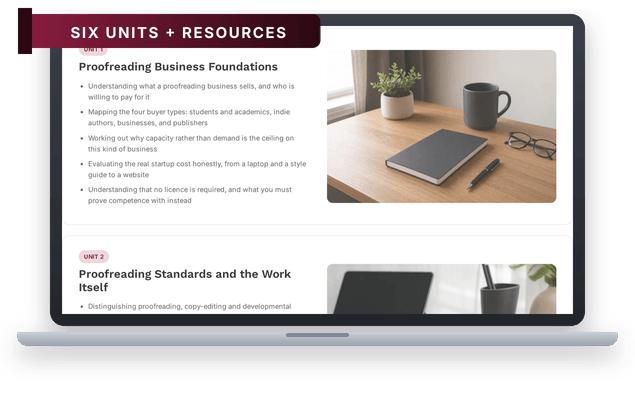
The Fundamentals course follows the same order as this guide. Unit 3, Setting Up Your Business, covers registration, terms of service, bookkeeping and handling unpublished manuscripts confidentially. Unit 2 teaches marking up in Track Changes, in PDF and on paper, and Unit 6 covers choosing one buyer type and the first twenty approaches.
For anyone aiming at books specifically, the Advanced course adds Unit 7, Specializing and Higher-Value Clients, on the conventions each specialty expects, and Unit 10 on retainers and seasonal planning, which matters when publishing schedules bunch work into a few months of the year.
Ready to get started?
Our step-by-step courses take you from where you are now to a credential you can show, with templates, an online exam, and a 30-day money-back guarantee.
See the courses