Copy Editing vs Proofreading and Where the Line Falls
Copy editing improves a text before it is laid out, fixing grammar, consistency, word choice and clarity. Proofreading is the final check on a near-finished text, catching the errors and layout faults that remain, without rewriting anything that is already correct. Copy editing comes first, takes longer and costs more.
The two words are used loosely, even by clients who commission both, so in practice the line between proofreading and copy editing is usually drawn by the person doing the work. Drawing it clearly matters, because quoting for one and delivering the other is one of the most common ways a new proofreader loses money.
The main differences between copy editing and proofreading
The Editorial Freelancers Association's service definitions describe copyediting as correcting spelling, grammar, usage and punctuation, checking cross-references, and preparing the style sheet that keeps a manuscript consistent. Proofreading is described as one of the last stages before publication, checking for typographical and formatting errors.
Set side by side, the two jobs differ on almost every practical point.
| Point | Copy editing | Proofreading |
|---|---|---|
| When it happens | Before layout, on the author's file | After layout, or on the final draft |
| What changes | Errors, consistency, clarity and word choice | Errors and layout faults only |
| What it produces | An edited file, queries and a style sheet | Marked corrections against that style sheet |
| Pages an hour | 5 to 9 | 7 to 12 |
| Median per word | 3.0 to 4.0 cents | 2.0 to 3.0 cents |
The pace row explains the price row. A copy editor reads more slowly because every sentence is a decision about whether it could be clearer, while a proofreader reads to confirm that what is there is correct. The figures come from the EFA's 2026 rate chart, built from a survey of more than 1,100 members.
A sentence edited both ways
One sentence shows the difference. Take "The comittee have decided that, going forward, the policy will be implemented in a phased manner over the course of the next year."
A proofreader corrects the spelling of "committee" and, if the style sheet says collective nouns take a singular verb, changes "have" to "has". The rest is wordy but correct, so it stays. A copy editor might also cut "going forward" and rewrite the end as "will phase the policy in over the next year", and would query the author if the meaning could change.
Proofreading on laid-out pages also covers things a copy editor never sees. Page numbers, running heads, a contents list that matches the chapters, a heading stranded at the foot of a page, and a word split badly across two lines all belong to the proofreader, because they only exist once the text is typeset.
Where both sit in the editing sequence
Copy editing and proofreading are two stages in a longer chain, and each stage assumes the one before it is finished. Reordering them wastes money, because a late structural change undoes the line-level work done on top of it.
A traditionally published book usually moves through four stages.
- 1
Developmental editing
Structure, argument, pacing and what belongs in the book at all.
Hands on a settled structure - 2
Line editing
Sentence and paragraph style, rhythm and tone.
Hands on settled wording - 3
Copy editing
Grammar, consistency, cross-references and the style sheet.
Hands on a clean file for layout - 4
Proofreading
The laid-out pages, checked for remaining errors and layout faults.
Outside publishing, the stages blur. A business report or a student thesis often goes straight from the author to one reader, and the client calls that pass "proofreading" whatever it involves. The professional bodies treat them as separate skills, and Editors Canada certification sets a separate exam for proofreading and for copy editing.
How to tell which service a document needs
Clients rarely say which one they want, and the word they use is not a reliable guide. A few questions, asked before quoting and checked against a sample of the file, usually settle it.
- Has anyone edited it yet? A first draft that nobody else has read needs a copy edit, whatever the client calls the job.
- Is the layout final? Typeset pages, or a document about to be printed, point to proofreading.
- What does the sample show? Two or three errors a page suggests a proofread. Sentences that need rebuilding suggest an edit.
- What is the client allowed to change? A student thesis or a contract may limit changes to errors only, which settles the scope before anything else.
When the answers point in different directions, offer both services with separate prices and let the client choose. That is clearer than a single quote for a job nobody has defined.
Why the line matters when you quote
The pace difference turns directly into money. Take a 60,000-word nonfiction manuscript, which is 240 pages of 250 words, and a proofreader charging $45 an hour. These are illustrative figures built from the EFA's median paces.
At 9.5 pages an hour, the middle of the proofreading range, the job takes about 25 hours and is quoted at $1,125. At 7 pages an hour, the middle of the copy editing range, the same file takes about 34 hours. Deliver a copy edit for the proofreading quote and the effective rate falls to about $33 an hour.
Students see the same gap in practice. Across the students we work with at the Proofreading Institute, the same practice chapter has taken about half as long again to copy edit as to proofread over the past year. Priced properly, the copy edit of that manuscript at $50 an hour would be about $1,700.
The cost does not stop at one job. The client now believes the extra work is part of proofreading, so the next quote starts from a misunderstanding. The guide on how much proofreaders charge covers pricing each service from a timed sample.
What to do when a proofread needs editing
The awkward case is a file sent for proofreading whose writing is clumsy rather than wrong. Fixing it is not what the client paid for, so the choice should be deliberate rather than something a proofreader drifts into.
Three responses work, in this order of preference:
- Query it. Flag the sentence, say what is unclear and let the author decide. On academic work this is often the only option, because universities limit what a third party may change.
- Mention it in the delivery note. A line such as "the second half of chapter four may need another look" is useful and often leads to paid work.
- Offer to quote for a copy edit. When the document clearly needs one, saying so plainly is a service, not an upsell.
Writing the line into the agreement
Most disputes about scope are prevented by one sentence in the quote and the contract. A good scope line names the service, what will be corrected, what will be queried rather than changed, and how many passes are included.
The proofreading services contract template includes a scope clause written this way, and the proofreading style sheet template records the decisions both stages work to.
A workable scope line for a proofread might say, "One full proofread of the typeset pages, correcting spelling, punctuation, consistency and layout errors against the agreed style sheet, with any wording problems raised as queries rather than changed." It is short, and it answers the question before the client has to ask it.
Where the course covers the boundary in depth
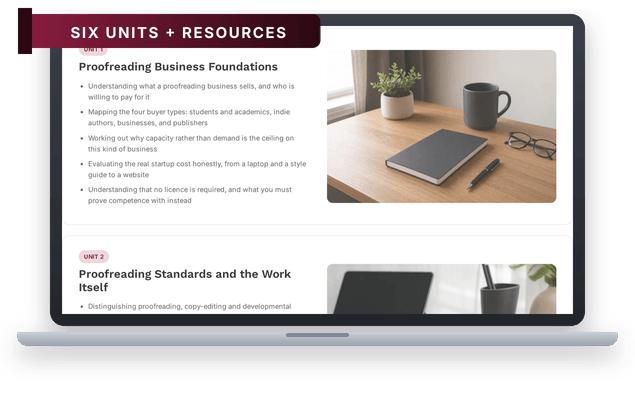
The Fundamentals course covers this in Unit 2, Proofreading Standards and the Work Itself, which teaches where proofreading stops and how professionals mark up work. Unit 4, Pricing Proofreading for Profit, covers quoting from a sample, and Unit 5 covers what to say when a file turns out worse than it looked.
Ready to get started?
Our step-by-step courses take you from where you are now to a credential you can show, with templates, an online exam, and a 30-day money-back guarantee.
See the courses