How to Make Money Proofreading
You make money proofreading by selling careful checking to the people who need it most, which means students and academics, independent authors, businesses and publishers. The work reaches a proofreader through direct clients, agencies, freelance platforms or a specialist niche. What it earns depends on two numbers, the hours actually billed each week and the effective rate for those hours.
Billed hours are always fewer than hours worked, and that gap decides most freelance incomes. This guide sets out the routes to paid work, then works a sample week through from stated assumptions so the arithmetic is visible. Rates themselves are covered in the guide to how much proofreaders charge, so they are only touched on here.
Who pays for proofreading
Proofreading is bought by people who cannot afford a public mistake. That narrows the market to four main kinds of buyer, and each one behaves differently when it comes to price, volume and how often it comes back.
The four groups below are worth knowing before choosing where to look for work.
- Students and academics. Theses, dissertations and journal articles, often on tight deadlines, with work that peaks around submission dates and falls away in summer.
- Independent authors. Self-published novels and nonfiction, usually one book at a time, with the chance of the next book and a referral if the first goes well.
- Businesses. Reports, websites, proposals and marketing copy, which arrive in smaller pieces but can turn into a standing arrangement.
- Publishers and agencies. Steady proofs against a house style, often at modest rates, with a test to pass before the first job.
No group is best for everyone. A former teacher may find academic clients easiest to reach, while someone from corporate communications already knows how businesses buy. Starting with the buyer you understand shortens the time to the first invoice.
The main routes to paid proofreading work
Each buyer can be reached in more than one way, and the route shapes the income as much as the buyer does. A platform job and a direct job for the same author can pay very differently once fees and the time spent bidding are counted.
The comparison below sets the routes side by side on how the work arrives and what each one costs a proofreader.
| Route | How the work arrives | What it costs you |
|---|---|---|
| Direct clients | Your own site, outreach and referrals | Slow to build, but you keep the whole fee |
| Agencies | Jobs assigned after a test edit | The agency keeps a share of the fee |
| Freelance platforms | Bidding on posted jobs | Platform fees and unpaid time spent bidding |
| Publishers | A freelance list, after a proofreading test | Set rates and a long wait to get on the list |
| A specialist niche | Referrals within one field, such as law | Time spent learning the field's conventions |
The pattern is a trade between speed and margin. Agencies and platforms produce work sooner but take part of every fee, while direct clients take months to build and then pay the most per hour. Most proofreaders start with the first kind and move toward the second.
Direct work also compounds, which is what makes it worth the wait. Across the students we work with at the Proofreading Institute, about one in three of those earning from proofreading in the last year said repeat clients and referrals brought in more than half their work. A client who returns costs nothing to find a second time.
What a working week of proofreading can earn
The clearest way to see the income is to work one week through. The figures here are an illustration of the method, not a market claim. They assume a part-time proofreader who sits down to work 25 hours a week and earns an effective $35 for each hour billed to a client.
Not every one of those hours is billable. Quoting, emails, invoicing, marketing and the time between jobs all fill part of the week, so this example assumes 60% of desk time is billed. It also assumes 46 working weeks a year, leaving room for holidays, illness and quiet spells.
The 10 unbilled hours a week cost $16,100 a year, more than thirteen times the business costs.
Tax then comes off the net figure. In the United States, the IRS self-employment tax rate is 15.3%, covering Social Security and Medicare, and it applies on top of ordinary income tax. A freelancer pays both halves that an employer and employee would otherwise split.
The same arithmetic can be run with your own numbers in the proofreading rate calculator, which works backward from the income you need to the rate that delivers it. Changing the billable share from 60% to 70% in this example adds about $4,000 a year without raising the rate at all.
How freelance income compares with a salaried job
Salaried proofreading jobs exist but are few. O*NET's profile of proofreaders and copy markers puts US employment at about 12,000 in 2024, projects a small decline over the following decade, and lists a 2025 median wage of $24.58 an hour, or $51,120 a year.
That salary is a useful benchmark rather than a target. A full-time freelancer has to bill enough hours at a high enough rate to match it after paying their own tax, equipment and time off.
Running the earlier example at full-time hours shows how hard that is. At 40 hours at the desk, 65% billed and the same $35 an hour, a proofreader bills 26 hours a week and earns $910. Over 46 weeks that comes to $41,860 in fees, still below the salaried median before any tax or costs come off.
The gap closes through the levers in the next section rather than through longer hours. A full-time freelancer who reaches $45 an hour in a specialty and bills three desk hours in four would take $62,100 in fees over the same 46 weeks, without working a longer week. The freelance proofreading income calculator shows how each change moves the yearly total.
The guide to how much proofreaders make sets out employed and freelance earnings in more detail.
Ways to raise what proofreading pays
The ledger points to the levers. Income rises when more of the week is billed, when each billed hour is worth more, or when less time goes into finding the next job. The changes that move those numbers most are practical ones.
- Quote from a sample. Timing a short sample of the actual file stops slow jobs from being priced as fast ones.
- Specialize. Legal, medical and academic work carries more risk, and clients pay more for someone who knows the conventions.
- Work faster without cutting corners. A checklist and a few find-and-replace routines reduce the time spent on every routine error.
- Turn one-off clients into standing ones. A business that sends a report every month removes a month of marketing.
- Charge separately for rush work. A 24-hour turnaround displaces other jobs, and the fee should reflect that.
Raising rates with existing clients belongs on the list too, though it is the one most new proofreaders avoid. A modest yearly increase, announced with notice, is normal practice in most freelance trades.
Proofreading offers that do not pay
Some "make money proofreading" offers make money only for the seller. Sites that charge a fee to join a job board, pay a fraction of a cent per word, or ask for a paid test before any work appears tend to cost more time than they return.
The difference between a real opportunity and a scheme is usually visible before any money changes hands. The guide asking whether online proofreading jobs are legit sets out the warning signs and how to check a platform or client. Real paying routes are covered in the guide on how to get proofreading jobs.
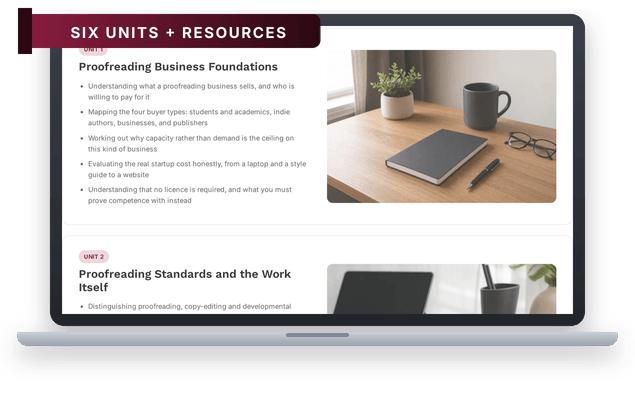
Where the course covers earning from proofreading
The Fundamentals course covers the first half of the ledger. Unit 4, Pricing Proofreading for Profit, teaches measuring your own words per hour and quoting from a sample, and Unit 6, Getting Your First Clients, covers choosing one buyer type and the platforms that actually produce paid work.
The Advanced course adds the second half. Unit 7 covers choosing a specialty and charging for higher-risk work, Unit 9 builds the workflow that raises throughput, and Unit 10, Scaling, Steady Income, and Long-Term Growth, deals with retainers, rate rises and the quiet academic summer.
Ready to get started?
Our step-by-step courses take you from where you are now to a credential you can show, with templates, an online exam, and a 30-day money-back guarantee.
See the courses