Proofreading Business Plan Template
A clear plan turns "I want to be a proofreader" into something you can act on. This fill-in-the-blank structure walks through every section a partner, a lender or a future you needs to see, including the two most plans in this trade leave out: how many words a week you can actually take on, and what happens in the months when the academic work stops.
See the coursesEverything on this page is yours to copy and adapt. The courses cover the decisions behind it: what to charge, what to promise, and what to put in writing.
What yours needs to cover
- ✓ A summary section that frames the business in a few sentences, including who you serve
- ✓ A buyer-type worksheet covering students and academics, indie authors, businesses and publishers
- ✓ A startup-cost section covering the laptop, the style guides, software, a website and insurance
- ✓ A rate section built from your own measured words per hour rather than from a forum average
- ✓ A capacity plan, because in this trade the ceiling is your throughput and not demand
- ✓ Month-by-month projections with real seasonality in them, not twelve equal months
How to use it
- Start with the buyer type, because it decides your rates, your marketing and your reading list.
- Measure your own words per hour on real text before writing a single number into the rate section.
- Put in your actual startup costs, which in this trade are small enough that the honest figure is itself the argument.
- Build the projections on your real capacity and a real calendar, then revisit them after your first ten paid jobs.
Why a proofreading plan is mostly about capacity
Most business plan templates assume the hard problem is finding customers. In proofreading the harder problem is usually time. You sell hours of concentrated reading, and there is a ceiling on how many of those a person can do well in a day before accuracy starts to slide. A plan that projects income without first stating how many words a week you can handle is describing a business that cannot exist.
So the plan here is built the other way round. It starts from the buyer you intend to serve and the speed you have actually measured, and only then turns those into revenue. That order keeps the numbers honest, and it also makes the plan useful later, because when a month goes badly you can see whether the problem was demand, price or throughput.
Filling in each section with real numbers
The summary should fit in a short paragraph: who you proofread for, what kind of documents, and how the work reaches you. "Proofreading for graduate students in the social sciences, sourced through university notice boards and referrals" is a summary. "Professional proofreading for all your needs" is a slogan, and it will not help you decide anything.
The buyer-type worksheet asks you to pick one of four groups and note what that group is afraid of. A doctoral candidate fears a thesis being referred back. An indie author fears a review that mentions typos. A business fears looking careless to its own customers. A publisher fears missing a print date. Each fear points at a different message and a different price.
For the rate and capacity sections, time yourself on three real documents of the kind you want to take, and record words per hour for each. Multiply a realistic number of focused hours per week by that speed and you have your weekly capacity. The projections then become a calendar exercise: which months your buyer is busy, which are quiet, and what you will do in the quiet ones.
How the plan connects to the rest of the business
Several later documents draw directly on this one. The rate card uses the speed you measured here. The startup checklist uses the cost section. The marketing you do in your first months follows from the buyer you chose. If you change one of those decisions later, come back and change the plan too, so it stays a working document rather than something written once and filed.
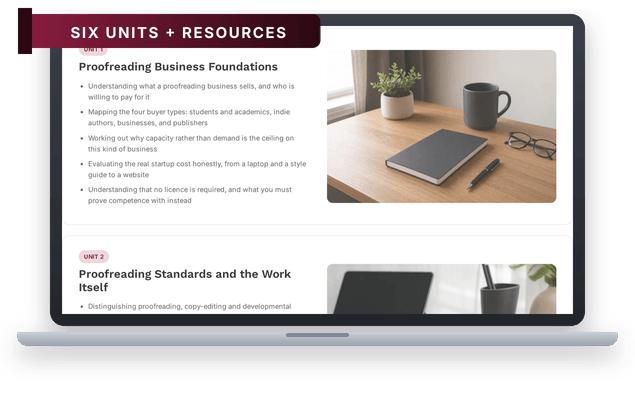
The course takes each of these sections in turn. Unit 1 covers buyer types, capacity and startup cost, and Unit 4 covers measuring speed and pricing from it, so by the end of the Fundamentals units you will have the evidence to fill in every line with your own figures.
A filled-in example
| Business name | Quiet Margin Proofreading (fictional) |
|---|---|
| Buyer type | Graduate students and early-career academics in the social sciences |
| Service | Proofreading of theses and journal articles to the university's own style rules, with a style sheet and a query log |
| Measured speed | About 2,500 words per hour on clean academic prose, about 1,500 on heavier drafts |
| Focused hours per week | 20, spread over five mornings |
| Weekly capacity | Roughly 30,000 to 50,000 words, depending on the state of the text |
| Quiet months | Midsummer and the winter break, planned for with business documents from two local firms |
Mistakes to avoid
- Projecting twelve identical months. Academic and publishing work both have seasons. Mark the months your buyer submits, publishes or shuts down, and let the projections rise and fall with them, so a quiet month is expected rather than alarming.
- Using someone else's speed. A figure read in a forum tells you about that person's texts and habits. Your rates are only as sound as the speed they are built on, so measure your own on real documents before writing any number in the plan.
- Writing for everyone. A plan that serves "anyone who needs proofreading" cannot choose a reading list, a price or a place to advertise. Pick one buyer for the first year and name the others as later options.
- Leaving out insurance and reference books. They are small costs, which is exactly why they get forgotten. A current style guide and some form of professional liability cover belong in the startup section from the first draft.
Proofreading Business Plan Template FAQs
Do I need a business plan to start proofreading?
Not legally. A short one is still worth writing, because it forces you to price from your own measured speed rather than from what somebody posted in a forum, and to face the quiet months before they arrive rather than during them.
Can I download a ready-made plan?
This page is the structure rather than a file: every section somebody needs to see, in the order to write them. The courses walk you through filling each one in with your own numbers, which is the part a blank document cannot do for you.
How do I plan for the quiet months?
Work out when your chosen buyer actually buys. Academic work clusters around submission deadlines and thins out over the summer, indie authors are steadier but lumpier per job, and business clients are the most even of the three. Your plan should name which of those you are exposed to and what you intend to do about it.
More proofreading business templates
Get every template, plus the training
Ten documents, one course that covers the thinking behind all of them, from the first quote to the contract you hand a commercial client.
Choose your course