Proofreading Business Startup Checklist
Most people starting out do the right things in the wrong order, and the usual casualty is pricing: a rate set before you know how fast you read is a guess you then have to defend to a client. This checklist puts the steps in the order that makes each one cheaper than it would otherwise have been.
See the coursesEverything on this page is yours to copy and adapt. The courses cover the decisions behind it: what to charge, what to promise, and what to put in writing.
What yours needs to cover
- ✓ The decisions to make before spending anything, starting with which buyer you are for
- ✓ A speed-measurement step, because every rate you will ever quote is derived from it
- ✓ Registration, structure and insurance, sized to a home-based service business
- ✓ The software and reference books worth buying first, and the ones that can wait
- ✓ The proof to assemble when you have no license to point at: samples and a test edit
- ✓ A first-client step with a specific number of approaches rather than "start marketing"
How to use it
- Pick one buyer type. Everything below is different depending on the answer.
- Measure your words per hour on three real documents before you price anything.
- Register, insure and open a business account, which together take an afternoon.
- Assemble the proof: two sample edits you may legally show, and a test-edit offer.
- Make twenty specific approaches and track the replies, because ten is too few to read anything from.
Why the order of the steps matters more than the steps
Almost every list of startup tasks for proofreaders contains the same items. What separates a smooth start from an expensive one is the sequence. Buying software before choosing a buyer means you may buy the wrong tools. Setting a price before measuring your speed means you will defend a number you cannot justify. Building a website before you have a sample edit means the site has nothing to show.
This checklist is arranged so that each decision supplies what the next one needs. The buyer tells you which style guide to buy. The style guide shapes your sample edits. Your measured speed sets your prices. And the sample, the price and the buyer together are what you put in front of your first twenty prospects.
Working through the five phases
Phase one is decisions only, with no spending. Choose one buyer type and write down in a sentence why you are suited to it. If you have worked in healthcare, law, engineering or a university, that background is often the strongest reason to pick a specialty.
Phase two is measurement. Take three documents of the kind your buyer produces, proofread them properly with a timer running, and note words per hour for each. Use the slowest of the three as your planning figure until you have real jobs to replace it.
Phase three is the administration: registering the business in whatever form is appropriate where you live, opening a separate account, arranging insurance and setting up a simple bookkeeping system. None of these is difficult, and doing them before the first invoice is much easier than doing them after it.
Phases four and five are about proof and outreach. Prepare two sample edits on text you have permission to show, such as public-domain passages or your own writing seeded with errors, and write a short test-edit offer. Then make twenty specific approaches and record every reply and every silence.
Where this checklist sits in the course
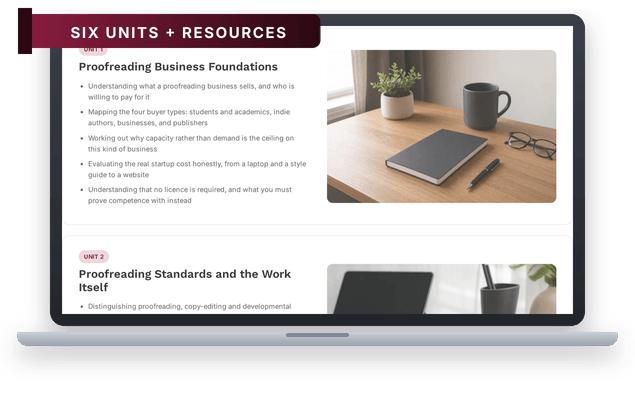
The checklist mirrors the order of the Fundamentals units. Unit 1 covers the buyer and the startup cost, Unit 3 the setup, Unit 4 the speed measurement and pricing, and Unit 6 the proof and the first approaches. If you work through the course, you can treat this page as the one-page summary of the first six units.
A filled-in example
| Buyer chosen | Indie fiction authors publishing their own ebooks |
|---|---|
| Reason | Reads widely in the genre and knows its conventions |
| Measured speed | Three chapters timed; slowest figure used for planning |
| Style references bought | A current general style manual and a standard American dictionary |
| Setup done | Business registered locally, separate bank account, liability cover arranged |
| Proof prepared | Two sample edits on public-domain chapters, plus a free 1,000-word test-edit offer |
| Approaches made | 20 authors contacted individually, 4 replies, 1 paid job |
Mistakes to avoid
- Spending before deciding. Courses, software and a logo all feel like progress. Choose the buyer and measure your speed first, then buy only what that buyer's work requires.
- Skipping the speed test. Without it every quote is a guess. An afternoon with a timer and three real documents gives you a figure you can price from and revise later.
- Stopping after five approaches. Five messages cannot tell you whether your offer works. Twenty, tracked in a simple list, starts to show a pattern in who replies and why.
- Showing client work without permission. Confidentiality is part of what you sell. Build samples from public-domain text or your own writing, never from something a client sent you.
Proofreading Business Startup Checklist FAQs
Do I need a qualification to start?
No. There is no licensing body for proofreading and no legal barrier to charging for it. That cuts both ways: nothing stops you starting, and nothing vouches for you either, so competence has to be demonstrated with a sample edit rather than asserted with a certificate. This is worth being clear-eyed about before you spend money on any training, including ours.
How much does it cost to start?
Less than almost any other business, which is genuinely the appeal. A computer you already own, a current style guide, optional software, a domain and some form of professional insurance covers it. Working through the startup cost calculator with your own figures takes a few minutes and beats any average.
What is the first thing to do?
Choose the buyer type, then measure your reading speed. Doing those two in that order makes every later decision, from which style guide to buy to what to charge, follow rather than be guessed at.
More proofreading business templates
Get every template, plus the training
Ten documents, one course that covers the thinking behind all of them, from the first quote to the contract you hand a commercial client.
Choose your course